Tuesday night the Democrats took the midterms.
Wednesday, Wall Street threw a party. Stocks rallied, Treasury yields fell, and the consensus by the closing bell was that this was all going to be fine.
The party lasted one day.
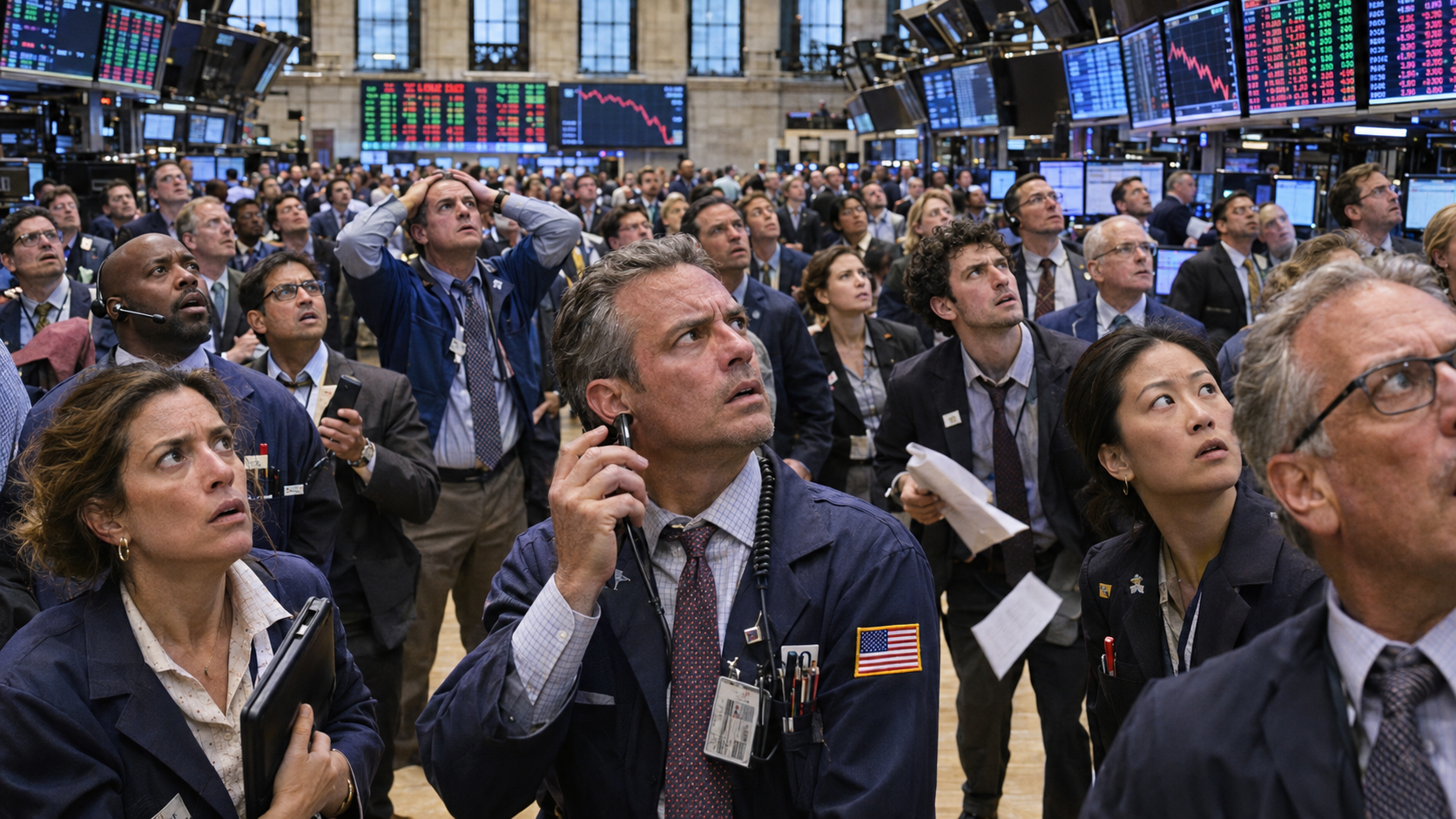
By Thursday afternoon, reports put the damage across US equities at more than $2 trillion. More than one outlet called it the steepest selloff since the tariff crash of April 2025.
Here is the part that should bother you.
No bank failed. No country defaulted. There was no war, no fraud, no earnings collapse, no hurricane. A member of Congress said out loud that advanced AI development should be paused, the market decided that was suddenly a real possibility, and the handful of companies that have carried US stock returns for three years fell together.
That is the entire cause. A sentence on Wednesday. Trillions on Thursday. Twenty four hours after everyone agreed it was fine.
You almost certainly own more of this than you think
Open your statement. Look at what you actually hold.
If any part of your retirement sits in an S&P 500 index fund, a target date fund, or a standard balanced portfolio, you do not own five hundred companies in any way that matters. You own a small group of enormous technology companies, and then a long tail of names that barely move the needle.
You did not choose that. It happened to you, slowly, over years, because those companies won and the index followed them up. Nobody sent you a letter about it.
But it means your retirement is now mostly a bet on one story. And on Thursday, every person holding that bet found out what happens when Washington decides to have an opinion about it.
You thought you were diversified. You were diversified on paper.
Nobody is going to warn you
Thursday arrived with no warning. No bell, no alert, no phone call.
Ask yourself who called you Thursday. Be honest about the answer. Probably nobody did.
Now, the AI pause proposal may well die in committee. Most proposals do. That is not the point.
The point is that Tuesday changed the arithmetic permanently. A political risk that the market had priced at roughly zero is now priced at something higher, and it stays higher through two solid years of hearings, bills, floor speeches and committee statements. Every single one of those is now a candidate to do what Wednesday's one sentence did.
You do not have to believe AI is a bubble. You only have to count how many more Thursdays are on the calendar between now and 2028.
And you are the one who cannot wait it out
This is where you are different from the 35 year old reading the same headline.
They have thirty years. A bad year is noise to them. They keep contributing on the way down, the market recovers, and they come out ahead for having lived through it.
You do not have thirty years. If you are five or ten years from needing this money, or you are already drawing on it, a bad stretch does not get averaged away. It gets locked in, because you have to sell into it to live.
The market shed more than $2 trillion on Thursday. What you lost, if you were fully exposed, is time you cannot get back.
Now look at what went up
Something else happened Thursday and almost nobody put it on the front page.
Gold rose more than 1%, through $4,120 an ounce, its highest level since October 21. It had already pushed above $4,000 the day before. Kitco's Thursday report put it plainly: gold climbed as yields fell.
Both days. While the AI trade came apart, gold went the other way.
That is not a coincidence and it is not complicated. When money leaves a crowded trade, it has to go somewhere. When yields fall, the cost of holding an asset that pays no interest falls along with them. That is the whole mechanism. And the next two years of hearings and bills on Capitol Hill are going to keep pulling both of those levers.
You did not miss it
This is the objection most people have, so let us face it directly.
Gold set a record near $5,600 an ounce in January of this year. It trades around $4,120 today.
Read that twice. The price is roughly $1,400 below its own high, and it started moving again in the same week the equity market found out how fragile it was.
If you had bought gold at the January record, you would be underwater right now. Anyone who tells you gold only goes up is lying to you, and you should stop listening to them. But the person making a decision today is not that January buyer. The entry available this week is a long way under the peak, in an asset that is currently rising while the thing in your 401k is falling.
That is a materially better position than the one most savers are sitting in tonight.
What the last thirteen midterms did
Kitco published a study of this two days before the vote, and the numbers are worth knowing.
There have been 13 midterm elections since 1974. Gold's November average price was higher a year later in 8 of them, and lower in 5. The average change was about 14% and the median was about 15%. After the 2018 midterms, gold rose roughly 20%. After 2022, about 15%.
Kitco is careful about this and so are we. Thirteen is a small sample. The individual outcomes range from a 22% fall to a 90% rise, and none of it proves the election itself caused the move. Eight out of thirteen is a tilt, not a law.
But it is the tilt. And you are standing at the front of a fourteenth.
How much actually changes anything
Our own view, and this is USA Capital Gold's position rather than anyone else's, is that 25 to 35 percent of retirement savings in physical gold is the range that genuinely changes your exposure.
Below that, you own a decoration. A 3% position does not protect a portfolio from a 15% drawdown in the other 97%. It just lets you tell people you own gold. The entire point is to hold enough that a bad stretch in equities does not get to decide what your retirement looks like.
Physical gold can be held inside a retirement account through a tax-free rollover under federal rules, which means repositioning a portion does not have to trigger a tax event. Most people have no idea that is even available to them.
What's inside the free guide
- How the repositioning actually works, step by step
- What portion makes sense for someone in your position, and why 3% is a decoration
- How the tax-free rollover is structured so moving a portion does not trigger a tax event
- The specific things to watch for when choosing a dealer
Common questions
Is the guide really free?
Yes. No cost and no obligation.
Is my information safe?
It is used to send your guide and occasional updates. Unsubscribe anytime.
The window is the window
Thursday showed you two things at once. Your retirement is more concentrated than you ever chose, and the asset that rose while that concentration cracked is still trading well below its own record.
Neither of those stays true forever. Gold does not wait for anyone to finish thinking it over, and the next sentence out of Washington is not going to come with a warning either.
This is general information, not advice for your specific situation. Your age, your tax picture and what else you hold all change the answer, and that is exactly why the guide exists. It walks through how the repositioning actually works, what portion makes sense for someone in your position, how the tax-free rollover is structured, and the specific things to watch for when choosing a dealer.
Download our free guide now.